


 中文简体
中文简体
Understanding Hydraulic Water Pumps Hydraulic water pumps are pivotal components in modern industrial, agricul...
READ MOREUnderwater Dredging Robot: Reshaping the Intelligent Future of Water Management with Core Advantages
In an era of accelerated water environment management, the Underwater Dredging Robot has become a frequently mentioned term in the industry due to its significant advantages. From intelligence to safety, from precision to adaptability, this type of equipment is driving profound changes in the management of rivers, lakes, reservoirs, and urban waterways with a series of irreplaceable core advantages.
High Intelligence Capabilities Lead to More Precise Management Results The most prominent advantage of underwater dredging robots is their high level of intelligence. Intelligence is not only reflected in the equipment's ability to autonomously plan paths and operational strategies, but also in its deep understanding of the underwater environment. Through multi-source sensing technologies such as sonar, high-definition imaging, and underwater sensors, the robot can acquire multi-dimensional data on silt distribution, underwater structure, and water conditions in a timely manner, and use this information for real-time decision-making, making the dredging process more scientific.
This intelligent decision-making capability transforms dredging operations from traditional experience-based operations to data-driven processes, enabling precise control of silt thickness, density, and distribution, avoiding ineffective and repetitive work, and making management more efficient. With increasingly stringent requirements for aquatic ecological restoration, the advantages of precise governance brought by intelligent systems are particularly crucial.
Unmanned Operations Reduce Risks and Enhance Continuity: Water management has long faced challenges such as hazardous working environments and the difficulty of manual underwater operations. Underwater dredging robots overcome these challenges through unmanned operation. Unmanned operation not only significantly improves operational safety but also overcomes human limitations, enabling dredging operations to maintain stable and efficient operation for longer periods.
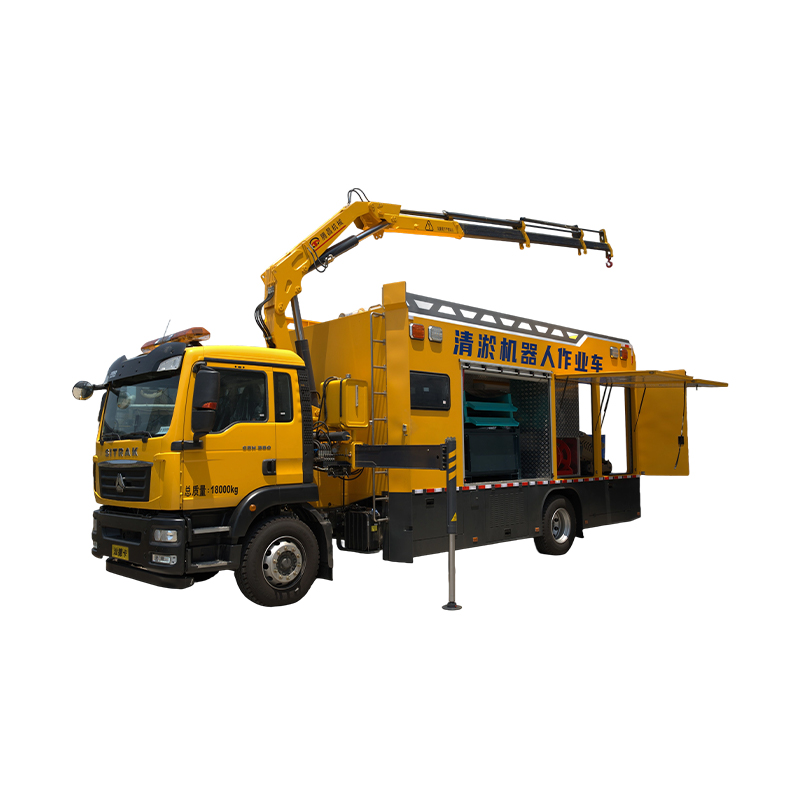
In scenarios with limited underwater visibility and frequent changes in water flow, traditional manual diving operations are often high-risk. Robots, through autonomous navigation and automatic obstacle avoidance technology, can maintain precise control in complex waters, unaffected by external factors. Furthermore, the continuous operation capability of unmanned systems allows for greater stability in large-scale restoration projects, reducing downtime for various water environment projects and improving overall governance efficiency.
Refined Dredging Reduces Ecological Disturbance: Modern aquatic ecological restoration emphasizes "precise treatment," avoiding the secondary damage to the ecosystem caused by crude treatment methods. Underwater dredging robots, with their high-precision operational capabilities, transform dredging from a large-scale, indiscriminate excavation into a gentle process based on precise positioning and analysis.
The advantages of this precision are multifaceted, including precise control of dredging depth, reduction of silt disturbance area, and protection of the benthic ecosystem. This refined approach makes the dredging process more aligned with ecological restoration principles, preventing damage to the underwater structure from over-cleaning and avoiding re-turbidity due to rough work. For urban water environment management that prioritizes ecological sustainability, this is an irreplaceable advantage.
Strong adaptability to diverse aquatic environments. The complexity of water management lies in the vast differences in water size, depth, flow velocity, and silt properties. Underwater dredging robots, with their modular structure and flexible propulsion system, possess strong environmental adaptability. Whether in narrow urban rivers, deep reservoirs, or lakes with complex siltation structures, the robot can maintain stable operation.
This adaptability makes the robot no longer limited to specific scenarios but a general-purpose device for managing various types of water bodies. Its compact mechanical structure facilitates deployment, while its flexible control system enables stable output under varying hydrodynamic conditions. As the industry's demands for efficiency and quality in water management continue to rise, this adaptability is becoming a key reason for choosing underwater dredging robots.
Sustainable Management Capabilities Facilitate Long-Term Aquatic Ecosystem Maintenance
Water environment management is not a one-off project but requires long-term maintenance and continuous monitoring. Underwater dredging robots can not only perform dredging tasks but also undertake long-term monitoring and data collection, shifting the management process from single-point operations to full lifecycle management.
Its sustainability advantage lies in its ability to continuously observe the underwater environment, allowing managers to understand water area trends through real-time data, adjust management strategies promptly, and maintain the stability of the aquatic ecosystem. By integrating with smart water management platforms, the robot can create a closed loop of monitoring, management, and feedback, enabling water environment management to move from traditional methods to an intelligent management system.
Technological Upgrade Potential Drives Continuous Industry Development
The advantages of underwater dredging robots are not static but continuously enhanced through technological iteration. The integration of artificial intelligence, underwater communication, materials science, and robotics gives them the potential for continuous evolution. This technological advancement means that robots will take on more functions in the future, extending from basic dredging to ecological restoration, pollution identification, and intelligent inspection, bringing higher-quality governance solutions to the entire industry.
Underwater Dredging Robots are reshaping modern water management models with their core advantages of intelligence, unmanned operation, precision, adaptability, and sustainability. These advantages not only improve governance efficiency but also promote the systematization and long-term effectiveness of water ecological restoration. With continuous technological breakthroughs, this type of intelligent equipment will continue to expand its influence in the industry, becoming a key force driving water environment governance to a higher level.
PREV:How is Modern Snow Removal Equipment Reshaping Urban Operational Efficiency in Winter?
NEXT:Industrial-Grade Hydraulic Tools: The Core Driving Force for High Productivity
NEXT:Industrial-Grade Hydraulic Tools: The Core Driving Force for High Productivity
Interested in cooperation or have questions?
News
-
-
What is an Underwater Dredging Robot Underwater Dredging Robot is an advanced mechanical device designed speci...
READ MORE -
Introduction Winter weather brings many challenges, and one of the most critical issues is snow and ice accumu...
READ MORE -
Selecting the optimal Hydraulic Power Unit (HPU) is a critical decision that directly impacts the efficiency, ...
READ MORE

-
Factory Address
Weiwu Road, Phase II, Shexian Economic Development Zone, Mount Huangshan City, Anhui Province, China
-
Mobile Phone
+86 15212700663
Stay Connected
lf you can't find the answer you're looking for, chat with our friendly team.
Stay Connected
Copyright © Huirui Intelligent Equipment Co., Ltd. All Rights Reserved.China Custom Hydraulic and Emergency Equipment Manufacturers
