


 中文简体
中文简体
Understanding Hydraulic Water Pumps Hydraulic water pumps are pivotal components in modern industrial, agricul...
READ MOREHow Can Underwater Dredging Robots Improve the Efficiency and Safety of Port Cleaning?
With technological advancements, underwater dredging operations are gradually shifting from traditional manual and mechanical methods to intelligent and automated approaches. Underwater dredging robots, as a core product of this transformation, are progressively changing the landscape of underwater operations. These robots, with their efficiency, precision, and reliability, are demonstrating immense application potential in various fields, including environmental protection, seabed resource extraction, and port maintenance.
Underwater Dredging Robots: A New Choice for Efficient Operations
Underwater dredging operations are typically used to remove sediment, debris, and pollutants from water bodies. These tasks often need to be performed in deep water, high-pressure, and complex environments. Traditional dredging operations rely on manual labor and large mechanical equipment, which is not only inefficient but also carries high operational risks. Underwater dredging robots have emerged in this context, utilizing advanced artificial intelligence technology, deep-sea exploration technology, and precision control systems to complete high-precision dredging tasks without human intervention.
Compared to traditional dredging equipment, underwater dredging robots offer significant advantages. First, they can perform comprehensive underwater operations, not affected by constraints from water depth, current speed, and other environmental factors. Second, the robots can work in extremely complex underwater environments, using high-precision sensors and intelligent systems to monitor surrounding environmental changes in real time and automatically adjust their operating methods, thereby improving operational efficiency and safety.
Core Technology: The Combination of Intelligence and Automation
The ability of underwater dredging robots to operate efficiently in various complex underwater environments is due to the powerful core technologies supporting them. From a hardware perspective, underwater dredging robots are typically equipped with high-precision deep-water detectors, automatic navigation systems, high-definition cameras, and advanced robotic arm systems. Through these hardware facilities, the robots can accurately obtain real-time information about the underwater environment and respond flexibly to rapidly changing conditions.
Underwater dredging robots also rely on highly intelligent software systems. This system integrates functions such as automated operation, real-time data analysis, path planning, and environmental monitoring, ensuring that the robots can autonomously complete dredging tasks. Especially in terms of path planning, underwater dredging robots can calculate the optimal work path through data collection and algorithmic analysis, reducing unnecessary operating time and energy consumption.
Application Areas: Diverse Market Prospects
Underwater dredging robots have a wide range of applications, covering various industries such as marine environmental protection, port construction, and resource extraction. In the field of marine environmental protection, underwater dredging robots can efficiently clean up underwater debris and sediment, effectively improving water quality and protecting aquatic ecosystems. The non-invasive operation method used by the robots does not cause any disturbance or harm to underwater organisms, meeting current environmental protection requirements.
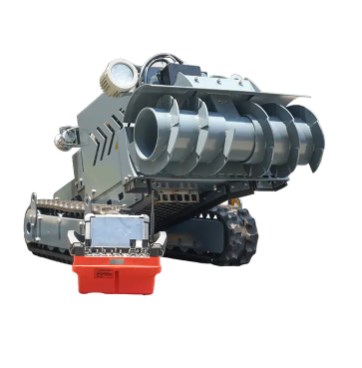
In terms of port construction and maintenance, underwater dredging robots can perform cleaning work in port channels, ensuring the smooth passage of ships. Traditional port cleaning work usually requires a large amount of manpower and mechanical equipment, while underwater dredging robots can complete tasks without human intervention, reducing labor costs and improving operational efficiency.
At the same time, underwater dredging robots also show strong potential in the field of seabed resource extraction. By equipping them with efficient cleaning and detection equipment, the robots can help develop deep-sea mineral resources, supporting the sustainable utilization of deep-sea resources.
Robot Design: Innovation and Challenges Coexist
The design of underwater dredging robots requires not only a high degree of innovation but also the ability to overcome various technical challenges. The underwater operating environment is very complex, and the robots need to possess characteristics such as high pressure resistance, corrosion resistance, and waterproofing. To cope with pressure changes in the deep-sea environment, the robot's shell usually uses special alloy materials to ensure stable operation even under extreme conditions. The robot also needs to be equipped with a powerful power system to support long-term underwater operations.
With the development of artificial intelligence technology, the autonomous navigation and decision-making capabilities of underwater dredging robots are continuously improving. The robots can autonomously identify underwater obstacles, accurately adjust their operating position, and upload data in real time for remote monitoring by operators. This intelligent control system greatly reduces the possibility of human error and improves the safety and accuracy of operations.
However, the research and development and application of underwater dredging robots still face some challenges. For example, in complex underwater environments, the stability of signal transmission and data feedback remains a problem. Underwater robots need to ensure stable data transmission for extended periods to obtain environmental data in real time and perform remote operations. The energy demands of deep-sea operations also require the robots to have the ability to work autonomously for extended periods, which places higher demands on battery technology.
FAQ
Q1: How deep can underwater dredging robots operate?
The operating depth of underwater dredging robots is closely related to their design and the technology used. Currently, underwater robots on the market can operate in waters several hundred meters deep or even deeper, and some high-end robots can even complete tasks in deep-sea environments exceeding several thousand meters.
Q2: Can underwater dredging robots adapt to complex seabed topography?
Yes, underwater dredging robots use high-precision navigation systems and sensors to perceive the underwater environment in real time, automatically avoid obstacles, and operate efficiently in complex seabed topography.
Q3: Does the operation of underwater dredging robots require human intervention?
Modern underwater dredging robots employ highly intelligent control systems and can complete most operations without human intervention. However, complex tasks or unforeseen emergencies may still require remote human operation.
Q4: How do underwater dredging robots ensure environmentally friendly operation?
Underwater dredging robots use non-invasive operating methods that do not disturb underwater life. Their precise operational control capabilities ensure that they can remove seabed debris and sediment without causing secondary pollution.
PREV:How to Choose the Right Snow Removal Equipment for Your Needs?
NEXT:How Do Hydraulic Tools Improve Industrial Production Efficiency?
NEXT:How Do Hydraulic Tools Improve Industrial Production Efficiency?
Interested in cooperation or have questions?
News
-
-
What is an Underwater Dredging Robot Underwater Dredging Robot is an advanced mechanical device designed speci...
READ MORE -
Introduction Winter weather brings many challenges, and one of the most critical issues is snow and ice accumu...
READ MORE -
Selecting the optimal Hydraulic Power Unit (HPU) is a critical decision that directly impacts the efficiency, ...
READ MORE

-
Factory Address
Weiwu Road, Phase II, Shexian Economic Development Zone, Mount Huangshan City, Anhui Province, China
-
Mobile Phone
+86 15212700663
Stay Connected
lf you can't find the answer you're looking for, chat with our friendly team.
Stay Connected
Copyright © Huirui Intelligent Equipment Co., Ltd. All Rights Reserved.China Custom Hydraulic and Emergency Equipment Manufacturers
